Projects and Research interests
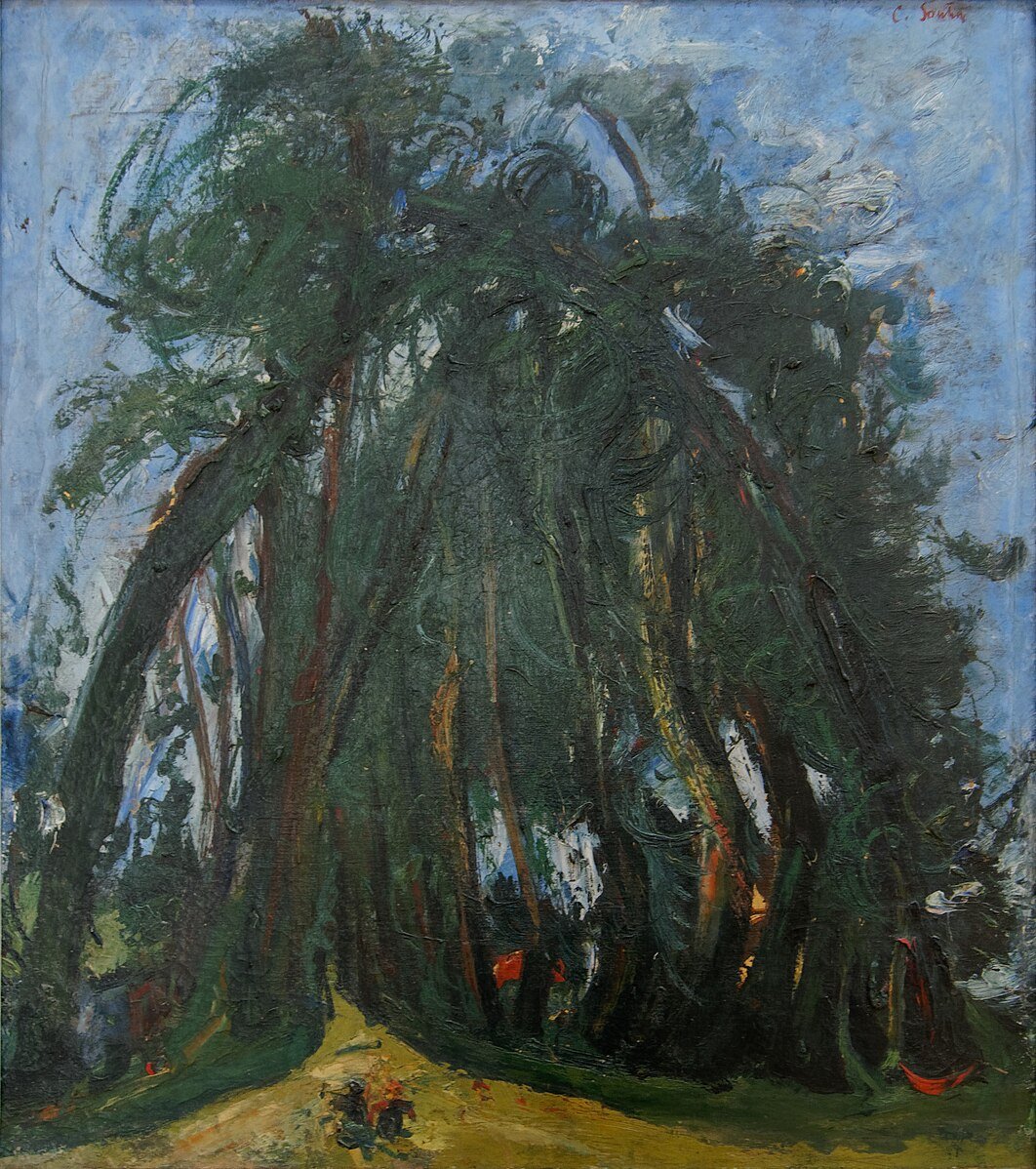
L'Allée d'arbres, tableau de Chaïm Soutine, Wikimedia Commons
Hegel and German Idealism (Past and Ongoing Projects)
While environmental philosophy anchors my current and future research, I also cultivate an interest in Hegel’s philosophy and its reception within contemporary epistemological debates. I published my first book, Modalities of Cognition: Understanding, Method, and Representation in Hegel (Pisa: ETS) in 2018. Here, I challenge the common misconception that Hegel lacks a substantive theory of cognition or a philosophy of science—a misconception that arises partly due to his critique of representation, understanding, and scientific methods in the Phenomenology of Spirit. I contend that representation and scientific practices (the quintessential expression of the understanding) are not defective mental activities but systematic forms of world-building that contribute to the articulation of the Idea. I show that Hegel’s sui generis epistemology defies classification under pragmatism, post-Kantian constructivism, or conceptual realism, and that human rationality is not confined to cognitive processes but is embedded within the ontological structures that shape both nature and reality.
Because questions of imagination and nature have long guided my engagement with Hegel’s thought, I have recently begun revisiting his philosophy in conversation with contemporary environmental concerns. As first steps in this direction, I organized a panel at the 63rd meeting of the Society for Phenomenology and Existential Philosophy on “Hegel and the Anthropocene” (SPEP 63, 2025). I am also working on an article in which I argue that Hegel’s account of abiotic phenomena offers an alternative to the flat ontology of new materialism, which often conflates distinct levels of normativity. I will present a preliminary version of this argument at “Hegel, Nature, and Culture in the Anthropocene Age” (XIII International Conference of the Brazilian Hegel Society, December 1–5, 2025).
I am actively researching and publishing in two areas of philosophy: (1) environmental, social, and political thought, and (2) the post-Kantian history of philosophy, with a particular focus on Hegel and Frankfurt School Critical Theory. What unites these strands is an interest in the dialectical relationship between nature and imagination, a dimension that has faced new challenges under the pressures of the environmental crisis. Overall, I am concerned with how imagination can reorient our social practices toward a more balanced relationship with the environment, and with how thinkers in the post-Kantian tradition have developed theoretical resources that remain relevant to contemporary debates.
Book Project
After defending my dissertation in April, I will work on a book project tentatively titled, “Social Imaginaries at the End: Imagination, Nature, and Social Practices under the Environmental Crisis,” situated at the intersection of environmental philosophy, 20th-century history of philosophy, and contemporary critical theory.
My main claim is that social change in the so-called Anthropocene requires an imaginary that is simultaneously (i) anti-utopian, (ii) grounded in nature, and (iii) based in local practices. This conception addresses what I identify as a central issue in contemporary critical theory, ecological Marxism, and public discussions on the environmental crisis: the repeated call to envision alternatives for a postcapitalist future is not paired with a reflection on the nature of imagination itself. Frameworks such as degrowth or ecological democracy often present imagination as a mental faculty that relates to the environment from the outside, thereby limiting our capacity to conceive concrete alternatives to neoliberal capitalism and its capture of individual imaginations. To develop new normative criteria for the relationship between imagination and nature, I turn to Cornelius Castoriadis. His theory of the imaginary not only represents a decisive break from traditions that frame imagination as a flight from the world—such as classical phenomenology and Critical Theory—but also enables a productive dialogue with ecofeminist, Black environmentalist, and green critical theory accounts that focus on the relationship between land, imagination, and structures of oppression. By bringing these thinkers into conversation, I argue that social imaginaries are not ideal projections but rather natural ontologies encompassing objects, institutions, bodies, and ecological processes. If imaginaries are not future visions “in our heads” but structures that keep us in place, then our understanding of social change requires inverting the order between possibility and reality. A new imaginary will not be a utopian construction but something discernible in ongoing practices. My suggestion is that commoning experiments operating at the intersection of nature and society (such as land stewardship, solidarity economies, food sovereignty, peer-to-peer networks) are the paradigmatic expression of an emergent imaginary that is shaping a post-capitalist world in the here and now.